EuMINe – A new COST Action Led by DAIMON on Digital Technologies and Artificial Intelligence for Advanced Materials

The DAIMON Team is taking the lead in the “EuMINe – European Materials Informatics Network” COST Action, a multidisciplinary European initiative aimed at revolutionizing the development of advanced materials through the application of digital technologies and artificial intelligence.
The first official meeting of the COST Action “EuMINe – European Materials Informatics Network” has just concluded. During the meeting, Francesco Mercuri, a researcher at the Institute for the Study of Nanostructured Materials of the CNR (ISMN-CNR) in Bologna and leader of the DAIMON research team, was appointed as the Chair of the Action by the Management Committee. The CNR was selected as the grant holder institution. This international initiative will span four years and is dedicated to revolutionizing the field of advanced material development and its applications in hi-tech sectors through the adoption of innovative approaches to digitization based on materials informatics, artificial intelligence, and data-driven technologies.
COST Actions represent one of the European Commission’s key initiatives to promote interdisciplinary research and innovation across all fields of science and technology, including emerging areas. COST Actions support networking initiatives and serve as a fundamental tool for promoting international cooperation, knowledge sharing, and scientific and technological progress in Europe and globally.
The multidisciplinary EuMINe community brings together experts in materials science, informatics, computer science, physics, chemistry, engineering, modeling, and simulation, industrial research, and technology transfer. Furthermore, the Action will actively collaborate with a wide range of stakeholders, including public and private institutions, communities engaged in materials modeling, design, and characterization, large-scale computing infrastructures, and materials-focused data centers.
The Action already encompasses dozens of researchers and innovators from both academic and industrial backgrounds and represents over 20 countries. One of the Action’s objectives is to further expand participation through various networking initiatives.
The COST Action “EuMINe” signifies a significant stride in European cooperation to advance science and technology in the materials field, unifying the efforts of researchers, innovators, and institutions across the continent to address the most pressing challenges in advanced materials. The primary goal is to coordinate the endeavors of the European scientific community to maximize the impact of innovations on materials for the benefit of society and industry, tackling critical socioeconomic challenges.
For more information about EuMINe and updates on the initiative, please visit the Action’s page on the COST website at https://www.cost.eu/actions/CA22143/.
DESIGN-IT – Digital twins and artificial intelligence for industrial applications

DESIGN-IT (DEcision Science desIGN platform for digItal Twins) aims to develop a decision support platform that leverages artificial intelligence techniques and digital twin approaches, from multiscale materials properties to manufacturing applications
The project aims at developing new platforms that are able to support complex decisions in advanced manufacturing applications. At the same time, the platform will allow users to design and generate new artificial intelligence-based applications using a zero-code approach, without requiring expertise in software development.
An overall investment of >5MEUR for a 36-months project
DESIGN-IT has been granted in the framework of the innovation initiatives of the Italian Ministry for Industry and Made in Italy (MIMIT) and Next Generation Europe (PNRR) funding. Coordinated by Spindox S.p.A., the DESIGN-IT consortium includes Mister Smart Innovation, Reepack and the DAIMON Team of CNR-ISMN.
A multi-level approach to digital innovation for sustainable manufacturing
DESIGN-IT focuses on a fully-digital innovation approach and emerging data-driven technologies:
- AI-based frameworks for decision support in complex environments
- Interconnected multi-level and multi-scale digital twins of target systems, from materials properties to complex processes and production systems
- Development of no-code platforms
- Advanced software technologies and infrastructures
DAIMON will contribute to DESIGN-IT with activities on the development of physical and data-driven modelling frameworks and their integration and high-performance implementation.
For more information about DESIGN-IT, look at the Spindox website. Stay tuned for updates!
#artificialIntelligence #AI #digitaltwin #digitalinnovation #multiscalemodelling #advancedmaterials #industry40 #NextGenerationEU #PNRR
MoMoTec: il progetto sulla smart mobility di Spindox con la partecipazione del team Daimon

L’ obiettivo di Momotec e’ sviluppare tecnologie a supporto dei nuovi servizi di mobilita’ e dei costruttori di veicoli e infrastrutture.
La mobilita’ dei cittadini nei centri urbani ed extra urbani si sta evolvendo ad un ritmo sempre piu’ sostenuto. Dal noleggio di veicoli, alla realizzazione di piste ciclabili ed alla preparazione verso la mobilita’ elettrica, i concetti di Personalized travel, Sustainable mobility, Inclusive mobility acquisiscono sempre piu’ importanza. Le tecnologie relative alla mobilita’ hanno un impatto dirompente sulla Green economy, con un ruolo importante a livello europeo come evidenziato dal Recovery Plan.
Allo stesso tempo sono in aumento i mezzi pubblici intelligenti per una maggiore efficienza delle risorse ed un maggior livello di servizio. Dalle ricerche di mercato emerge che il contenuto software nei veicoli stia crescendo dell’ 11%, per arrivare al 30% nel 2030.
Il progetto Momotec – Modern Mobility Tecnological Ecosystem – realizzato con il contributo per l’accesso regionale di insediamento e sviluppo in attuazione dell’ Art. 6 LR 14/2014 – bando 2019 si inserisce in questo contesto. Il progetto coordinato da Spindox , azienda operativa nel settore ICT, e prevede la partecipazione del team Daimon del CNR-ISMN e del consorzio Mister. Il progetto si basa su un’analisi degli elementi strategici e sull’ utilizzo dell’ intelligenza artificiale nell’ ambito della mobilita’ intelligente (connettivita’ dei veicoli, mobility-as-a-service, etc). Il progetto include inoltre ricerche su come alcuni dispositivi possano essere utilizzati in ambito smart mobility per migliorare la sicurezza del guidatore, dei passeggeri e degli altri utenti della strada, siano essi veicoli o pedoni. Tra questi la telecamera a bordo veicolo (dash cam) e l’head-up display (HUD) integrato con soluzioni di realta’ aumentata.
I tre obiettivi di Momotec
Momotec prevede la realizzazione di tre obiettivi nell’ ambito della Modern Mobility, grazie al ruolo importante svolto da Spindox e dei suoi partner.
- II primo obiettivo del progetto consiste nella realizzazione di un’ infrastuttura software per la configurazione rapida e la messa in servizio (deploy) di applicazioni per la gestione di servizi di mobilita’ sia per strutture pubbliche che private. La piattaforma realizzera’ previsione della domanda di mobilita’ per tipologia di utente, servizio o prodotto richiesto e l’ ottimizzazione dell’ allocazione delle risorse.
- Il secondo obiettivo consiste nella realizzazione di componenti da integrare alla piattaforma, facili da utilizzare da parte dei costruttori di veicoli. Questo obiettivo vuole inoltre favorire l’ Inclusive Mobility svolgendo attivita’ di R&D per soluzioni di AI e bot di interazione vocale e gestuale che facilitino la mobilita’ alle persone ipovedenti, in collaborazione con l’Istituto dei Ciechi Francesco Cavazza di Bologna. Lo studio della mobilita’ stato integrato con un questionario inviato a persone ipovedenti, analizzando il grado di accettabilita’ da parte degli utenti delle diverse tecnologie ad oggi disponibili e formulando proposte per una nuova tecnologia in grado di coadiuvare la mobilita’ di ciechi e ipovedenti.
- Il terzo obiettivo e’ focalizzato sulla realizzazione di strumenti di simulazione di risorse, processi e traffico che potranno anche fungere da digital twin, per consentire una migliore progettazione del servizio e delle infrastrutture. In questo modo e’ possibile stimare le performance tecniche ed economiche del servizio offerto e valutare i diversi scenari. Il team Daimon e’ attivamente coinvolto nella realizzazione di questo obiettivo, contribuendo allo sviluppo ed implementazione di piattaforme per la microsimulazione di scenari di mobilita’ in ambito urbano ed extraurbano.
Cosa manca alla fine del progetto?
Il progetto si concludera’ a fine 2022. Le attivita’ in corso riguardano la realizzazione di sistemi di interfacciamento tra le piattaforme sviluppate, il test delle funzionalita’ ed il deployment su sistemi in-cloud. Nella fase finale del progetto, le simulazioni verranno validate sulla base di scenari reali, ottenuti tramite dati geospaziali e demografici, all’ interno di un’ area geografica delimitata.
Il vantaggio principale nell’ uso di strumenti di simulazione, come la piattaforma realizzata in collaborazione con il team Daimon, deriva dalla possibilita’ di generare scenari diversi corrispondenti a casi reali, come giorni lavorativi, festivi, oppure situazioni dovute a chiusure di tratte per lavori di manutenzione.
Le attivita’ del team Daimon del CNR-ISMN e le collaborazioni
Il team Daimon collabora attivamente con Spindox e Mister Smart Innovation per la realizzazione di una piattaforma di microsimulazione in ambito urbano, sperimentato in prima istanza sulla citta’ di Bologna. E’ in questa citta’ che, allo stato attuale, e’ disponibile il maggior numero di dati sul traffico.
Il simulatore e’ stato realizzato a partire dalla piattaforma opensource Sumo (Simulation of Urban MObility). E’ stato successivamente integrato con dati di traffico messi a disposizione dal Dipartimento DICAM dell’Universita’ di Bologna. La piattaforma di simulazione e’ progettata per poter essere nativamente integrata con la piattaforma di ottimizzazione realizzata da Spindox.
Oltre allo sviluppo delle piattaforme di microsimulazione, l’implementazione tramite tecnologie software scalabili (containers) e la realizzazione di workflow data-driven, le attivita’ di Daimon riguardano anche l’implementazione delle piattaforme di simulazione su sistemi ad alte prestazioni (high-performance computing) e l’interconnessione tra simulazioni e piattaforme per l’intelligenza artificiale e big-data in ambito mobilita’ .
Link all’articolo completo su spindox.it per ulteriori informazioni sul progetto Momotec
#mobilita #smartmobility #cnr #artificialintelligence #modelling #hpc #computing #bologna
Unisciti a noi per il primo Dottorato di Ricerca Nazionale in Intelligenza Artificiale!

Il nostro team e’ alla ricerca di candidati neolaureati per progetti sullo sviluppo e l’ applicazione di metodi di AI nell’ ambito dei nuovi materiali, nanotecnologie e Industria 4.0.
L’ offerta e’ destinata a neolaureati in discipline scientifico/ingegneristiche con esperienza e/o interesse in tecnologie di AI e computazionali. Il Dottorato di Ricerca sara’ svolto in collaborazione con prestigiosi atenei italiani (v. www.phd-ai.it). Le attivita’ avranno luogo principalmente presso l’ Area di Ricerca CNR di Bologna, in collaborazione con numerose istituzioni internazionali, accademiche, e del settore produttivo.
Se sei interessata/o, o per ulteriori informazioni, contattaci o manda un messaggio a francesco.mercuri – at – cnr.it entro il 15 Luglio 2021 – ti aspettiamo!
Do you want to take part in the first edition of the Italian National PhD in Artificial Intelligence?
Our team is looking for candidates for projects on the development and application of AI-based methods for new materials, nanotechnology and Industry 4.0.
The offer is directed towards candidates with a degree in scientific or engineering subjects with experience and/or interest in AI and computational technologies. The PhD activities will be carried out in collaboration with renowned italian academic institutions (see www.phd-ai.it). Activities will mainly take place at the CNR Research Area in Bologna, Italy, in the framework of an extended network of international collaborations from academia and industry.
If interested, or for any further information, contact us or send an email to francesco.mercuri – at – cnr.it before July 15 2021 – come join us!
Predicting the morphology of organic molecular thin-films on substrates

One of the longest-standing issues in the development of advanced molecular materials for applications in technology concerns the following question: how does the molecular structure affects the properties of the “aggregated” materials? Generally speaking, this question is at the basis of crystal structure prediction (CSP). The relationship between molecular structure and, for example, solid-state packing, is extremely relevant in the development of new drugs. However, the same question arises in the development of applications based on molecular materials. In many applications, organic molecules are deposited onto a substrate to form a thin-film at the interface. The properties of the molecular materials at the interface, in turn, may control several critical processes in applications.[1][2]
The properties of molecular aggregates depend crucially on the peculiar molecular structure.[3] This means that even tiny changes of the molecular structure can alter significantly the local and long-range aggregation, leading to potentially strong modifications of the materials properties.[4] However, the formation of molecular aggregates onto substrates constitutes a subset of the incredible task of determining the many likely ways a molecule can aggregate with other molecules of the same kind. Molecular aggregation on surfaces is ruled essentially by two driving forces: 1. The molecule-molecule interaction and 2. The molecule-substrate interaction. The interplay between these two components, also balanced by the external conditions, determines the growth of molecular aggregates onto substrates. These interactions are governed by weak (van der Waals) forces, leading to a very complex landscape, featuring several different aggregation morphologies in which the system can likely be trapped.
Unfortunately, generic CSP approaches are not yet successful in predicting the morphology of molecular aggregates as a function of the molecular structure and in different conditions and environments. The majority of predictive approaches relies on the evaluation and ranking of different aggregation morphologies. In principle, the particular case of growth of molecular aggregates on substrate could be simulated by molecular dynamics (MD), throwing individual molecules towards a bare substrate, one after the other, until the desired surface density is reached. This “direct” method clashes with one of the major limitations of atomistic MD methods, that is, relatively short simulation timescales. For nanosized systems, MD can reach a few microseconds of simulation time, which is, unfortunately, several orders of magnitudes shorter than real deposition times. For example, if we simulate by MD the growth onto a flat substrate of a molecular monolayer with a height of 1 nm in 1us, we have a growth rate of about 1e6 nm/second, which is about 1e6 times (!) larger than a realistic rate (about 0.1-0.01 Ang/min). In addition, the simulation itself could take several days even on a supercomputer. This means that, in the best case, with “direct” MD we are simulating a particular growth process, in which we do not provide the molecules with enough time to “relax” energetically. Of course, this is a typical issue related to all MD simulations (just to mention one example, protein folding is also difficult to simulate by MD for similar reasons). However, to simulate aggregation onto a surface we can take advantage of the specific conditions and think about some hack.
We can apply two principles:
- Simulation temperature accelerates the dynamics of molecular systems. In our simulated world, we can assign different temperatures to different parts of a complex system, with the purpose of triggering different dynamical effects.
- The relative strength of the molecule-molecule interaction, with respect to the molecule-substrate interaction, can be tweaked in simulations. This would change the energy landscape that controls aggregation.
We can use these two “hacks” for the definition of a relatively simple computational protocol for the simulation of the growth of molecular aggregates onto substrates. The simulation steps required are shown below:

With these principles in mind, we can play with the simulation conditions and interaction potential to favor some processes with respect to others, and consequently observe different aggregation morphologies. The modification of interaction potentials and the differential equilibrium temperatures lead to a strong unbalancing of the initial energy landscape, leading to processes that occur within times that are compatible with the typical simulation times of molecular dynamics. If for example we reduce the interaction energy of a system that is trapped into a local minimum, we may lower the barrier for transition to a lower energy minimum. If we subsequently restore the pristine interaction potential, we finally get a thermally equilibrated system in a different state:

We applied this protocol to predict the morphology of a molecular system, a perylene diimide derivative, which is used in organic electronics, onto graphene. In principle, we can extend the same simulation protocol to other molecules and substrates.

By playing with growth conditions, we obtained a set of different aggregation morphologies, from very disordered to fully ordered aggregates:

The predicted morphologies are in excellent agreement with the available experiments. The structure of molecular aggregates in kinetically- or thermodynamically-controlled conditions (or even in intermediate conditions) are correctly reproduced. Moreover, simulations allow us to predict several aspects of molecular growth and aggregation, including, for example, the occurrence of grain boundaries.
The simulation protocol is therefore able to link molecular structure, processing conditions and resulting morphology of molecular aggregates at the interface with a substrate. The predictive power of this approach enables a step forward in the engineering of molecular structures for applications in technology.
Part of this work has recently been published on Advanced Theory and Simulations [5].
References
[1] Correlation between gate-dielectric morphology at the nanoscale and charge transport properties in organic field-effect transistors. A Lorenzoni, M Muccini, F Mercuri. RSC Advances 5 (16), 11797-11805, 2015.
[2] Nanoscale morphology and electronic coupling at the interface between indium tin oxide and organic molecular materials. A Lorenzoni, AM Conte, A Pecchia, F Mercuri. Nanoscale 10 (19), 9376-9385, 2018.
[3] Theoretical insights on morphology and charge transport properties of two-dimensional N, N′-ditridecylperylene-3, 4, 9, 10-tetra carboxylic diimide aggregates. A Lorenzoni, F Gallino, M Muccini, F Mercuri. RSC Advances 6 (47), 40724-40730, 2016.
[4] Redox-switchable devices based on functionalized graphene nanoribbons. D Selli, M Baldoni, A Sgamellotti, F Mercuri. Nanoscale 4 (4), 1350-1354, 2012.
[5] A Computational Predictive Approach for Controlling the Morphology of Functional Molecular Aggregates on Substrates. A Lorenzoni, M Muccini, F Mercuri. Adv. Theory Simul. 2, 1900156, 2019.
Designing two-dimensional materials for electronics: from computational predictions to fabrication and applications

The quest for high-performance materials for applications in several fields of technology has already demonstrated the potential of two-dimensional and layered compounds. The most notable case is that of graphene, a two-dimensional allotrope of carbon. [1] [2] However, other materials with a layered structure exhibit remarkable properties and a huge potential for applications. Among these, black phosphorus, a layered allotrope of phosphorus, is one of the most promising. The interest in black phosphorus emerges especially in terms of its potential for electronic and optoelectronic applications. In 2014, single-layer black phosphorus, or phosphorene, was also fabricated.
However, a major drawback hampers the use of single- and few-layer black phosphorus in real life: as in many other allotropes, black phosphorus reacts quite wildly with several agents in ordinary environments, such as water and oxygen. As a result, black phosphorus is essentially useless in air or wet atmosphere, as it rapidly gets oxidized. In other words, we have potentially great materials, but we cannot use them directly for applications in direct contact with air.
What if we were to protect the extremely sensitive black phosphorus layer with inert, more atmosphere-resistant materials?
Looking for materials that are essentially inert and that interact weakly with other materials, we ended up with linear alkanes. The elongated structure of alkanes allows to form compact structures onto planar or pseudo-planar surfaces. If the coverage is efficient, the black phosphorus layer would be protected by a layer of alkanes, keeping most of its intrinsic properties essentially unchanged. This actually happens because long-chain alkanes tend to form well-aligned structures on several surfaces, as in the cartoon below.

The process for protecting black phosphorus with alkanes is therefore quite easy: we just need to spread a thin layer of selected alkanes, which are in the liquid phase at room temperature, over the black phosphorus surface. Done.
Based on this idea, we performed molecular dynamics simulations to see what happens when you actually spread black phosphorus with liquid alkanes. We already applied molecular dynamics simulation with success to the study of materials for electronics.[3][4]
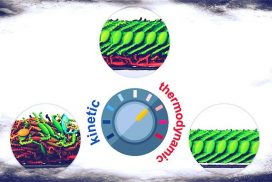
The result is not trivial: liquid phases mean that the structure of alkanes is extremely disordered, and you could expect formation of large amorphous and unstructured aggregates onto black phosphorus. To our surprise, however, spreading linear alkanes (tetracosane in this case) over black phosphorus resulted in the spontaneous formation of a well-packed protective layer. This is a representative snapshot extracted from simulations.

The alkane layer cover efficiently a large fraction of the exposed surface area. Moreover, DFT calculations confirmed that the interaction between alkanes and black phosphorus is essentially quite weak. Surface passivation with alkanes should therefore affect only marginally the electronic properties of black phosphorus.
Motivated by the computational predictions, experiments were also performed, confirming that alkane forms a compact layer on the surface that is able to protect black phosphorus from oxidation: the regions where oxidation of black phosphorus seem to occur are those that are apparently covered less efficiently with alkanes.

Despite the issues related to environmental stability, applications of two-dimensional phosphorus start to see the light. However, the properties of novel materials need to be tested in real-life scenarios. In this context, the full predictive power of computational modelling is unravelled, by providing properties of materials beyond ideality and models of suitable experimental processing. Part of this work has recently been published on Nanoscale: [5]
https://pubs.rsc.org/en/content/articlelanding/2019/NR/C9NR01155B
References
[1] Redox-switchable devices based on functionalized graphene nanoribbons. D Selli, M Baldoni, A Sgamellotti, F Mercuri. Nanoscale 4 (4), 1350-1354, 2012
[2] Evidence of benzenoid domains in nanographenes. M Baldoni, F Mercuri. Physical Chemistry Chemical Physics 17 (3), 2088-2093, 2015
[3] Correlation between gate-dielectric morphology at the nanoscale and charge transport properties in organic field-effect transistors. A Lorenzoni, M Muccini, F Mercuri. RSC Advances 5 (16), 11797-11805, 2015
[4] Theoretical insights on morphology and charge transport properties of two-dimensional N, N′-ditridecylperylene-3, 4, 9, 10-tetra carboxylic diimide aggregates. A Lorenzoni, F Gallino, M Muccini, F Mercuri. RSC Advances 6 (47), 40724-40730, 2016
[5] Epitaxial multilayers of alkanes on two-dimensional black phosphorus as passivating and electrically insulating nanostructures. A Lorenzoni, F Mercuri et al. Nanoscale 11 (37), 17252-17261, 2019
Designing new materials for stable, efficient, inexpensive solar cells: from modelling to industrial scale-up

Efficient and direct conversion of sunlight into electricity is definitely attractive. Latest promising technologies for the development of photovoltaics devices are based on perovskite solar cells (PSCs), which exhibit a power conversion efficiency above 20%. PSCs are essentially a sandwich of several ultra-thin (sub-micron) layers of different materials combined together, forming a thin-film. The surface area can reach several square centimeters.
However, PSCs are generally expensive and environmentally unstable. Overall costs are generally related to the need to fabricate special materials, which need several synthetic steps. Other specific properties of materials must also be tuned to reach high efficiency, but this may lead to environmental instability. In particular, the thin layer that is potentially exposed to atmospheric agents, air, humidity, etc. is particularly prone to be degraded by the environment. Protective layers can in principle be added, but this would mean additional costs.
Here comes our idea.
We designed a novel set of molecules, which have all the desired properties for having high power conversion efficiency, and, at the same time, are chemically stable and easy to fabricate. The molecules are based on phthalocyanines, a very versatile class of compounds that has been used already for more than one century. We know that this class of molecules can be used for PCS. But we need some other information.
How can we design the precise structure of the molecule, starting from some basic information and targeting specific properties of the molecular layer? Simulations helped us to predict what is the structure of the molecule that potentially perform bests, among a set of candidate.
By combining different functionalities, we ended up with this molecule:

On the basis of the molecular structure, we performed molecular simulations, modelling the morphology of aggregates in the actual material (thin) layer. We already used this approach in other similar situations [1][2][3]. By using molecular dynamics, we obtained the realistic morphology of this particular layer at an atomistic level of detail, which is clearly not accessible from the experiments. A representative configuration of the molecular packing looks like the image below:

This extreme detail has allowed us to understand how molecules pack together in the real device, a property that is extremely relevant to high power conversion efficiency. We have also analyzed how these property change when we try to engineer molecular structure. For example, simulations told us that some molecular functionalities were more efficient than other. In other words, we could relate the details of the molecular structure to a specific property through computational models and simulations. On the basis of these predictions, the most efficient molecules were synthetized and used in PSCs.
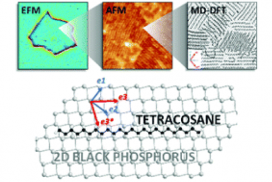
The result was amazing: as expected, these new materials were quite easy to fabricate and 20 times less expensive with respect to standard materials. The overall efficiency of the solar cell, without any special optimization, reached 19.7%, which is very close to record efficiency. In addition, the fabricated cells are super-stable, and can operate in harsh environments, without protection, for several days without losing most of their efficiency:

Several issues still need to be addressed in detail. However, we know that the integration between predictive modelling, targeting realistic systems, and advanced fabrication, can enable big steps forward in solar cell technology. More importantly, we have now everything we need for large-scale fabrication of solar cells based on perovskite materials.
Most of this work was carried out in collaboration with the Southern University of Science and Technology (SUSTech) in Shenzhen, China, and has recently been published on Advanced Energy Materials[4]:
https://onlinelibrary.wiley.com/doi/full/10.1002/aenm.201901019
References
[1] Correlation between gate-dielectric morphology at the nanoscale and charge transport properties in organic field-effect transistors. A Lorenzoni, M Muccini, F Mercuri. RSC Advances 5 (16), 11797-11805, 2015
[2] Theoretical insights on morphology and charge transport properties of two-dimensional N, N′-ditridecylperylene-3, 4, 9, 10-tetra carboxylic diimide aggregates. A Lorenzoni, F Gallino, M Muccini, F Mercuri. RSC Advances 6 (47), 40724-40730, 2016
[3] Spatial and orientational dependence of electron transfer parameters in aggregates of iridium-containing host materials for OLEDs: coupling constrained density functional with molecular dynamics. M Baldoni, A Lorenzoni, A Pecchia, F Mercuri. Physical Chemistry Chemical Physics 20 (45), 28393-28399, 2018.
[4] High‐Performance and Stable Perovskite Solar Cells Based on Dopant‐Free Arylamine‐Substituted Copper (II) Phthalocyanine Hole‐Transporting Materials. Y Feng, Q Hu, E Rezaee, M Li, ZX Xu, A Lorenzoni, F Mercuri, M Muccini. Advanced Energy Materials, 1901019, 2019
Opportunità per Tesi di Laurea e Tirocini
L’unità di ricerca sul Modelling di Nanostrutture e Dispositivi (DAIMON) presso l’Istituto per lo Studio dei Materiali Nanostrutturati (ISMN) del CNR Bologna offre a studenti in Chimica, Chimica Industriale, Informatica, Fisica, Ingegneria o Scienza dei Materiali l’opportunità di essere inseriti nel proprio gruppo di ricerca per tesi di laurea e tirocini su metodi avanzati per lo sviluppo di materiali, dispositivi e nanotecnologie.
L’unità di modelling opera in stretta collaborazione con i gruppi sperimentali del CNR Bologna e con leaders industriali nello sviluppo di materiali e dispositivi per applicazioni tecnologiche in elettronica, fotonica, fotovoltaico e bioelettronica, focalizzando l’attività di ricerca sull’applicazione di metodi di simulazione avanzati e multiscala, machine learning, intelligenza artificiale e calcolo ad alte prestazioni.
Per collaborazioni su tesi di laurea e tirocini, si incoraggiano richieste da parte di studenti con conoscenze di base su metodi per il calcolo scientifico, familiarità con l’ambiente Unix/Linux ed interessati ad approfondire tematiche legate all’utilizzo di metodi computazionali in chimica, fisica, informatica e scienze dei materiali.
Informazioni possono essere richieste presso:
DAIMON Team – CNR ISMN Bologna
email: daimoners@gmail.com
Web: http://daimoners.eu
Twitter: http://twitter.com/daimoners
Come visit us!

Grants for short-term visits (3-13 weeks) are available within the HPC-Europa3 consortium for research projects in the field of computational materials science and computational nanotechnology.
Projects on the application of high-performance computing, machine learning and deep learning for materials science are particularly welcome.
The HPC-Europa consortium provides full support of travel and living expenses and grants computing time on high-performance infrastructures for the whole duration of the visit. You will have the opportunity to exploit the outstanding computing capabilities of the CINECA supercomputing center and to enjoy a stay in Bologna, one of the most lively cities in Italy!
Please contact us for applications and further information.